My Marketing Team Is Two AIs and a Knowledge Base
Every morning, before I solved this, I opened a new Claude session and pasted the same paragraph. Here's what Hjarni is. Here's the voice. Here's the priority list this week. The same ritual, every day, for months.
Your AI starts from zero. That's the tax nobody talks about.
I built my way out of it. Now two AI assistants run most of Hjarni's growth program without me re-explaining anything. Last week Claude read a Google Search Console export and flagged the zero-click pages. ChatGPT rewrote their titles before I'd finished my coffee. They both work out of the same place: a knowledge base I sell as a product and use to run the business.
Three folders do the work
Strategy. Execution. Content. That's the whole system.
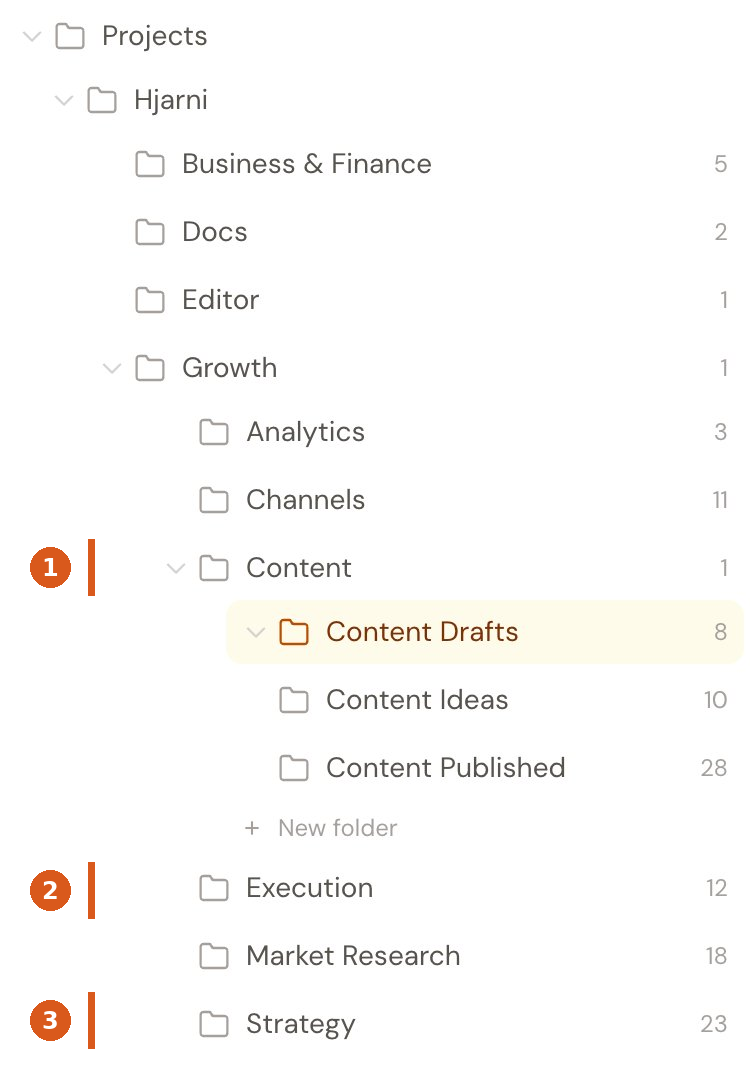
Strategy holds the playbook. The copywriting guide. The positioning. The SEO priorities. Reference documents that change slowly and change on purpose.
Execution is the task queue. Directory submissions, blog post checklists, SEO fixes. Each task is its own note. When it's done, it gets archived.
Content is the pipeline. Ideas, drafts, published. A post moves through three folders and ends with a canonical URL attached to it.
Every one of these folders has custom instructions baked in. When Claude opens a note in Strategy, it already knows the voice. When ChatGPT picks up a task in Execution, it knows how to update the checklist and which notes to link. The folder structure isn't decoration. It's how the AIs know what to do.
One real loop
Last month's SEO cycle looked like this.
Google Search Console data lands in a note inside my SEO snapshots folder. Claude reads it and flags which pages are eating impressions but getting no clicks. It writes the findings back as a list of URLs with current titles and suggested rewrites.
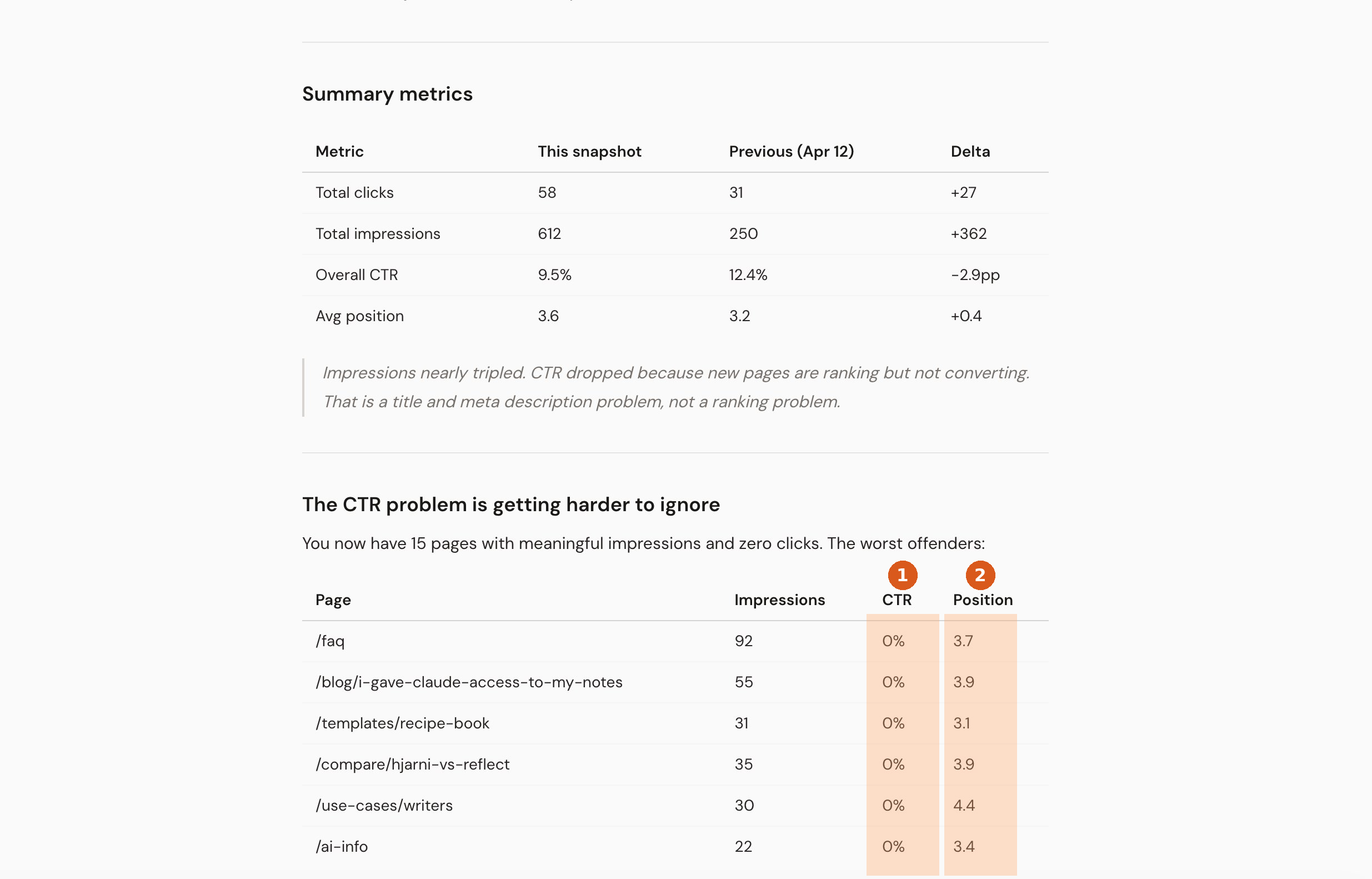
ChatGPT picks up the list in the next session. It reads the copywriting guide. Rewrites the titles and meta descriptions. Drops them back in the same note with a short rationale for each change.
I spend fifteen minutes reviewing. Approved rewrites go live. Next week's snapshot tells me whether click-through rate moved.
That's the loop. No spreadsheet. No kanban board. No context pasted into a chat window. Just notes that both AIs can read and write.
What makes this possible
The trick isn't the model. It's the system around it. Both AIs can read my structure, follow my rules, and write back in the same place I do.
That takes three things. An official MCP server. That's the protocol that lets Claude and ChatGPT read and write outside tools. Custom instructions per folder, so the AI picks up the voice and the process without being told each time. And notes that are designed to be written by an AI, not just exported to one.
Hjarni was built around those three things. That's what AI-native knowledge base actually means. Not a note tool with a chatbot on top.
The copywriting guide is a note
Here's the part I find funny. The document that defines how Hjarni talks to the world is a note inside Hjarni. Pulled up every time Claude or ChatGPT writes marketing copy. Edited in the same editor as everything else. Versioned alongside the rest of my brain.
My AI reads my notes about how my AI should write. Then it writes. Then I approve. Then the result ships. This is Hjarni for writers in its most literal form.
You can't do that if your knowledge base doesn't know how to talk to an AI.
The point
I'm not dogfooding to prove a point. I'm using my own product because nothing I've tried closes the loop this cleanly.
If you're running a solo project and you're still pasting the same context into a new chat every morning, stop. Give your AI a memory. Put your playbook, your tasks, and your drafts somewhere it can actually read them.
Write once. You both remember.
One knowledge base your whole team's AI reads. Free.
Start a shared brain your teammates' Claude and ChatGPT read and write. Free for your first 25 team notes.
One knowledge base your whole team's AI reads. Free.