The problem
Every conversation with Claude or ChatGPT starts from scratch on your codebase. You explain your project structure. Your naming conventions. Why you chose Postgres over MySQL. That the auth layer uses a custom middleware. Then you do it again tomorrow.
Note-taking for developers, built for your AI to read
Write down what your AI needs to know. Architecture decisions. API conventions. Deployment notes. Debugging playbooks. Connect Hjarni as an MCP server and your AI can search and read those notes whenever a task calls for them, or when you ask. A standing instruction to check Hjarni first makes it look before it answers.
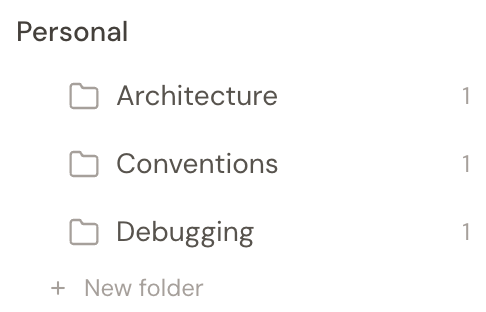
A typical developer setup
- Architecture folder: stack overview, service boundaries, database schema notes
- Conventions folder: naming, error handling, test patterns, PR guidelines
- Debugging folder: known issues, past incidents, environment quirks
- AI instructions on each folder: "When asked about deployments, check the runbook first"
Skip the blank slate
The Knowledge Wiki template gives you a ready-made structure for capturing architecture decisions, conventions, and operational knowledge. Paste the template link into Claude or ChatGPT and it creates the initial structure for you.
A concrete workflow
You're debugging a production issue. You ask Claude about the retry logic in your payment service. Claude checks your notes and finds you use Sidekiq with exponential backoff. That retries are capped at 5. That the payment service wraps Stripe. It doesn't guess. It reads your notes.
After the fix, you save what you learned. Next conversation, it's already there.
Questions like "What does our auth middleware do?" and "Why did we choose Sidekiq?" get better answers when the reasoning is already written down and your assistant can read it.
The gist stack, hosted
Karpathy's LLM Wiki gist showed the pattern. A maintained brain instead of RAG. Run it locally if you live in a terminal. Hjarni is the same pattern, hosted. Claude and ChatGPT read your notes. No vault on your laptop. The full breakdown is in Karpathy's LLM Wiki is right.
Why not just use a README or wiki?
READMEs are for humans. Your AI doesn't read your GitHub wiki when you open a new chat. Hjarni is a note system that both you and your AI can use. Folder-level instructions shape how the AI behaves in different contexts.
Your AI remembers a few facts about you. It doesn't remember your codebase.
What developers keep in Hjarni
- Architecture notes: service boundaries, design decisions, and system tradeoffs
- Operational runbooks: deploy steps, incident notes, rollback plans, and environment quirks
- Engineering conventions: naming, testing, error handling, and review expectations
- Project-specific instructions: folder-level guidance that tells your assistant how to behave in each codebase
- Team memory: a shared place for the context new engineers and new AI chats always need
- Portable notes: Markdown export and API access when you want to use the data elsewhere
When your whole team needs it
The notes that keep your AI current can become your team's shared context. Put architecture, conventions, and runbooks in a shared team space and every engineer's Claude or ChatGPT reads the same source. Per-folder roles let you decide who can edit what, and a new hire can ask from that context on day one instead of interrupting a senior engineer. See Hjarni for Teams.