Never Lose Your Startup's Knowledge
Every startup says knowledge matters.
Then someone leaves. A customer asks why you made a decision six months ago. Nobody knows where the answer is.
It was in Slack. Or Notion. Or in the founder's head.
You wrote it down. You still cannot get it back.
The problem is not storage. It is recall.
Your team already writes things down. Meeting notes, product decisions, customer feedback, launch plans. The notes exist.
But nobody can pull the right context back up when it matters. So that knowledge might as well not exist.
An engineer solves a painful bug. The fix stays buried in a Slack thread. A teammate leaves and takes half the context behind a workflow with them. A new hire asks a simple question. Three people give three different answers.
That is not a documentation problem. That is amnesia.
Knowledge retrieval at startups
Where does your context go?
Without Hjarni
Decision made
Lost in chat
Buried in docs
In founder's head
Team can't find context
Founder becomes the search engine
With Hjarni
Decision made
Saved in linked notes
AI reads your notes via MCP
Team gets answers
Founder is free to build
The tools are broken too
Docs are static. Chat is noisy. Wikis go stale. Folder structures only work if someone already knows where to look.
Slack is not memory. A wiki nobody searches is decoration. And AI without context just makes confident guesses.
You paste background. You explain decisions. You remind the assistant what your company does and why. Every single time.
That is not memory. That is manual recovery.
What if your AI already knew?
This is where Hjarni changes things.
Hjarni is a note-taking app your AI can actually use.
You write notes in Markdown. Simple, fast. No page builders. No 40-tab workspace. You link related notes together. And your AI assistant reads them directly through MCP.
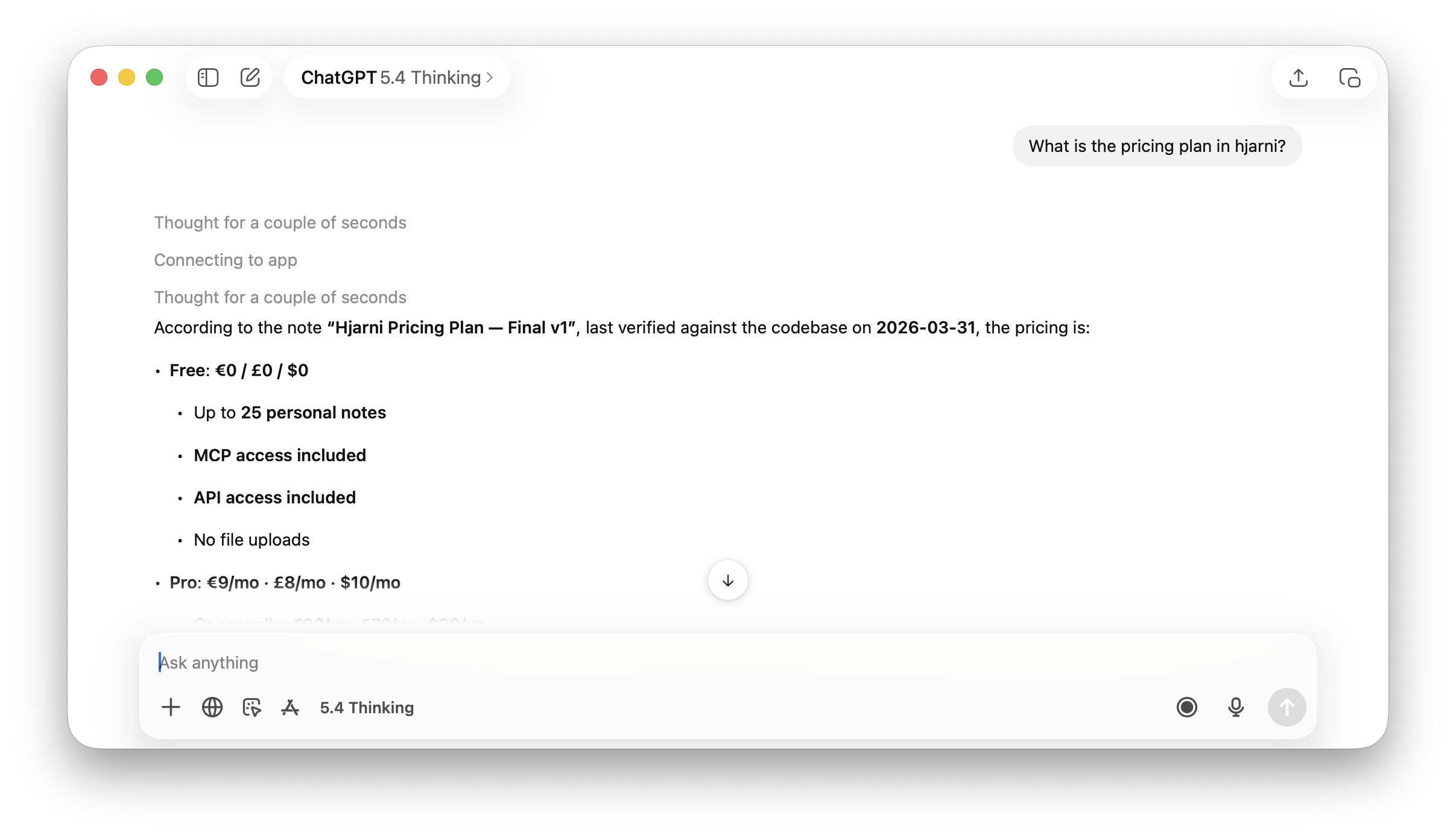
No copy-pasting context. No starting from scratch every conversation. Claude (or any MCP-compatible AI) searches your notes and pulls the right context back in. The answer is grounded in what your team actually knows.
Not what it guesses. What you wrote down.
Documentation stops being dead storage. It becomes something your team and your AI use right now.
What Hjarni is not
No databases. No kanban boards. No page builders. No dashboards pretending to be a knowledge base.
Hjarni does one thing well: notes for two readers. You and your AI.
We left the noise out on purpose.
When the founder becomes the search engine
Losing knowledge rarely looks dramatic. It looks like friction.
The same explanation rewritten for the third time. A new hire waiting days for context. An engineer making a call without knowing the history behind it. You answering questions nobody else can answer.
If every answer routes back through you, you do not have a knowledge system. You have a single point of failure. That is the problem Hjarni for founders is built around.
Most startups notice this too late. After someone leaves. After context disappears. After they start rebuilding decisions from scraps.
By then you are not building memory. You are doing archaeology.
Fix it while things are still small enough to shape. Not heavyweight process docs. Just a simple habit: capture what matters, connect it, keep it accessible.
Hjarni keeps the useful parts alive: a shared knowledge base for your team your AI can read, where memory does not vanish when the conversation ends.
Startups move fast. Your knowledge should not vanish just because you do.
One knowledge base your whole team's AI reads. Free.
Start a shared brain your teammates' Claude and ChatGPT read and write. Free for your first 25 team notes.
One knowledge base your whole team's AI reads. Free.