One brain for your whole company
Your company's brain.
The one your AI reads.
One shared, living memory for everything your company knows: decisions, runbooks, customer truth, the conventions in someone's head. Connected assistants can retrieve the relevant notes when your team asks, so people spend less time re-explaining the same context.
Teams is $20 per seat per month. Bring your own Claude or ChatGPT.
The problem
Your company knows a lot. Your AI knows none of it.
The reason you picked Postgres. What Sarah said about pricing. The deploy runbook. The thing the founder always repeats. Right now that knowledge is scattered across Slack threads, a Notion page no one updated, a Google Doc, and three people's heads.
So every AI conversation starts cold. A new hire asks Claude how deploys work, and it doesn't know. A founder asks ChatGPT what you decided about pricing last quarter, and it doesn't know. Everyone re-explains the same context to their own AI, every week.
A company brain fixes the fragmentation at the source: write it down once, and every teammate's AI reads the same thing.
How it works
Write it once. Ready for your team’s AI.
Plain Markdown notes in shared folders, read by whichever AI each teammate already uses.
One shared knowledge base
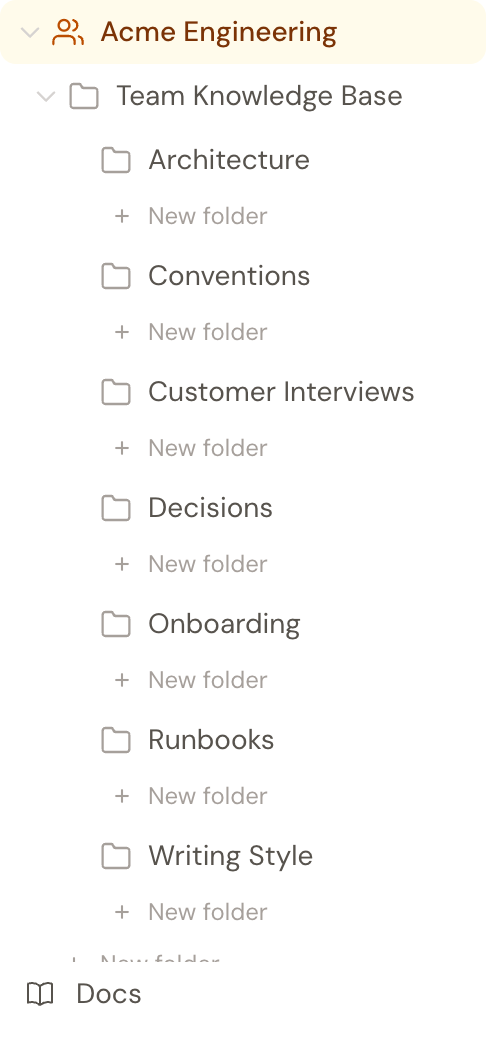
Decisions, runbooks, customer interviews, onboarding, and conventions live in shared folders your whole team can see. Personal notes stay personal.
Folders that carry rules
Each folder can have its own AI instructions: "search this folder first, quote the source, follow these steps." These instructions guide your AI; they do not guarantee that it follows them.
Read through MCP
The official MCP server lets Claude and ChatGPT search and read the brain before they answer. No copy-paste, no per-seat AI bill from us. Use your AI's own instructions to encourage retrieval, and ask it to check the notes when context matters.
What lives in the brain
The context you keep re-explaining.
One folder per kind of knowledge. Each becomes something your AI can answer from.
Decisions
Why you picked Postgres, why pricing went flat, what you tried and rejected. The institutional memory most companies lose when someone leaves.
Runbooks
Deploys, rollbacks, incident playbooks. A runbook your AI can read is a first responder at 3am, not a doc nobody opens.
Customer interviews
Calls, themes, and verbatim quotes. Ask what your last ten customers said about onboarding and get a real answer.
Onboarding
The unwritten context a new hire normally extracts from senior people one interruption at a time. Their AI reads it on day one.
Conventions
How you name things, how you write, the standards everyone is supposed to know. Now the AI knows them too.
Strategy
Positioning, ICP, board prep, investor questions. So ChatGPT drafts from your company's reality, not generic advice.
Why AI-native matters
A wiki is a brain no one reads.
The work of writing things down is the same. What changes is who, and what, does the reading.
Notion / Confluence wiki
Established options for team documents and structured work. AI access depends on the product and connection; Notion offers official MCP. Compare Hjarni vs Notion.
ChatGPT memory / Claude Projects
Native memory can carry context across chats. Claude Projects can share knowledge and instructions on eligible Team and Enterprise plans, subject to organization settings. That context stays within the assistant's product unless you transfer it or use a separate connection. Compare Hjarni vs ChatGPT Memory.
Hjarni company brain
Plain Markdown you own, shared across the team, and available for connected assistants to retrieve through the official MCP server. One source of truth, many readers.
I wanted a cloud knowledge base I could use as memory for my AI, in plain Markdown, with read and write access. Nothing else fit. Hjarni did. What sold me was how light and well defined the MCP is. My AI used to choke when I pasted Markdown and config files into a chat. It reads them perfectly from Hjarni. The folder-level AI instructions and the knowledge graph are the parts I did not know I needed.
Common questions
Common questions
What is a company brain?
One shared, living knowledge base of everything your company knows: decisions, runbooks, customer truth, conventions, and onboarding. In Hjarni, these are maintained Markdown notes that your team and compatible connected assistants can retrieve and update. Ask the assistant to check the relevant notes before answering.
How is this different from a wiki or Notion?
Notion and other knowledge products can also support external assistants. Hjarni focuses on maintained Markdown notes with folders, shared team roles and inherited instructions. The assistant still needs to retrieve the relevant notes and save any agreed edits.
How is a company brain different from Hjarni for Teams?
Same product, two framings. Hjarni for Teams describes the plan and day-to-day workflows. A company brain is the idea behind it: one maintained source of company knowledge that teammates and their compatible connected assistants can use. If you are comparing plans, start with the teams page.
Do all teammates need their own AI subscription?
Each teammate uses a compatible AI client and account. A paid subscription is needed only where that client’s connection or feature requirements call for one; workspace settings and approvals also apply. Hjarni does not bundle a model or charge per AI message.
Does a company brain work if teammates use different AI tools?
Yes. Compatible ChatGPT, Claude, Cursor and other MCP clients can connect to the same Hjarni team knowledge and use tools within the member’s permissions. The assistant must retrieve a note to use it. Native memory and project features also retain context within their own products, and Claude Projects supports sharing on eligible plans.
Who owns the data in the company brain?
You retain your content and can export active notes and attachments as a Markdown ZIP. Revision history and folder instructions are separate from that standard export. Check the exported text, links and attachments before moving to another app.
How do we keep the company brain accurate as it grows?
Review important notes and their history, and ask your connected assistant to save agreed changes. Folder instructions can guide source checking, organization and writing conventions, but they do not guarantee an update or enforce permissions. People can inspect and correct the notes directly.
Your notes on every device
Hjarni has its own native apps. Free on every plan for iPhone, iPad and Apple Silicon Mac and Android. Same account, same notes as the web. An internet connection is required.
Give your company one memory.
Start writing down what your company knows, and let every teammate's AI read the same thing.
Bring your own Claude or ChatGPT. No bundled AI, no per-message fees.